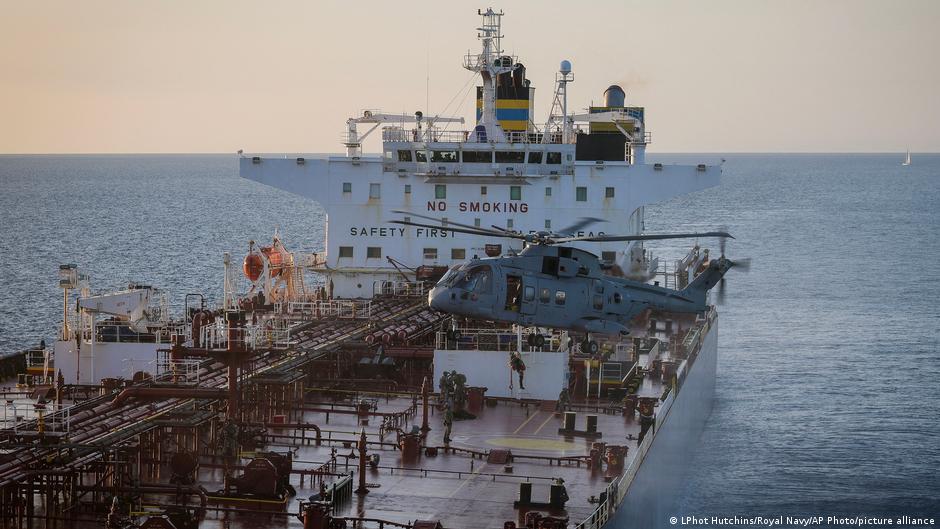
But detaining such vessels is far from straightforward, Julian Pawlak, a maritime security expert at the German Institute for International and Security Affairs (SWP) in Berlin, told DW. International maritime law, he noted, is fundamentally designed to protect the freedom of commercial shipping. "The transport of these goods on the high seas is not, in itself, illegal," Pawlak explains. What complicates matters is that parts of this shadow fleet are linked to so-called , including acts of sabotage, espionage, and possibly drone operations and related disruptions. "
Germany has not done enough to address the issue so far, argues Sara Nanni, a security policy spokesperson for the . In a recent interview with DW, she complained: "Russia is financing both and its aggressive behavior toward Europe through its shadow fleet. " Action must be taken against it, she said. "That is the only thing that could persuade Russia to return to the negotiating table," she argued.
Germany blames Russia for attempted terror attack in Leipzig
Finland shows another way to tackle the shadow fleet
By "other countries," she is referring, for example, to Finland. In late 2024, the tanker in the Gulf of Finland by dragging an anchor across the seabed. Finnish border guards subsequently detained the vessel.
Although a court later dismissed charges of aggravated criminal damage, Sönke Marahrens, a security expert at Kiel University, praised the Finnish response in an interview with DW: "They sent a clear message to the other side: We know what you're doing, and we're stopping you. And you could see that after this clear warning, the other side got the message and changed its behavior. "
In addition to Finland, the United Kingdom, France and Sweden have also adopted a tougher approach toward suspicious vessels. Within its territorial waters, the Swedish Coast Guard specifically targets tankers and cargo ships suspected of belonging to the shadow fleet for inspection. Vessels are routinely detained if they are found to be carrying forged documents, lack adequate insurance, pose a risk to maritime safety, or violate environmental regulations.
Russia's threats: Just a bluff?
It is easy to assume that the German government's restraint is aimed at avoiding an escalation with Russia. That impression is reinforced by the fact that the (AfD), which is considered right-wing extremist in parts, won the state election in the small state of Saxony-Anhalt on a platform that, despite the war in Ukraine, advocates closer relations between Germany and Russia. According to opinion polls, concerns about the prospect of war in Europe were also a decisive factor for many voters. Russia's foreign minister, Sergei Lavrov, even described Germany's accusations against Moscow as "the beginning of a real war. "
Johannes Peters of the Institute for Security Policy at Kiel University, however, believes such fears are unfounded: "Other European countries have taken a more robust approach, and despite those concerns, and indeed despite Russian rhetoric, very little has actually happened. Russia has not escalated the situation. Instead, it has largely steered clear of confrontation. In particular, we have seen that laden tankers, which are extremely valuable, are now avoiding Swedish waters because Sweden has stepped up efforts to stop and inspect vessels. "
After the attempted attack on Leipzig Airport, Chancellor said: "The federal government will make those responsible for hybrid attacks pay a price. They will pay for it. " Peters believes: "If you use strong rhetoric, sooner or later you have to back it up with action. The chancellor has put the government under pressure to follow through. "
Why did Norway seize a Russian ship for Ukraine?
Estonia experienced those risks firsthand in the case of the oil tanker "Jaguar. " In May 2025, the vessel's captain ignored instructions from the Estonian authorities while passing through the country's coastal waters. Estonian officials attempted to stop and inspect the suspicious tanker. Russia responded by scrambling a fighter jet, prompting Estonia to stand down and allow the vessel to continue on its way.
"It is important to consider the region in which these activities are taking place," Pawlak says. "In the Baltic Sea, Russia is naturally much closer geographically and therefore has other options at its disposal, including the deployment of military units in support. " Farther afield, however, for example in the English Channel between the United Kingdom and France, that becomes more difficult: "Russia cannot escort or protect every shadow fleet vessel. "
Explained: How Germany will expand intel powers, and why
He offers a simple example: "If only one ship a day can make the journey instead of three, that translates into losses of hundreds of millions of euros a day. If a voyage takes not x days but x plus four, that, too, cuts into Russia's earnings. And revenue from oil exports is vital to Russia's war economy. "
This article has been translated from German.
What Germany's move to officially blame Russia for the suspected hybrid attack at Leipzig airport means for Germany and NATO was the topic of discussion in DW's weekly Berlin Briefing podcast.
