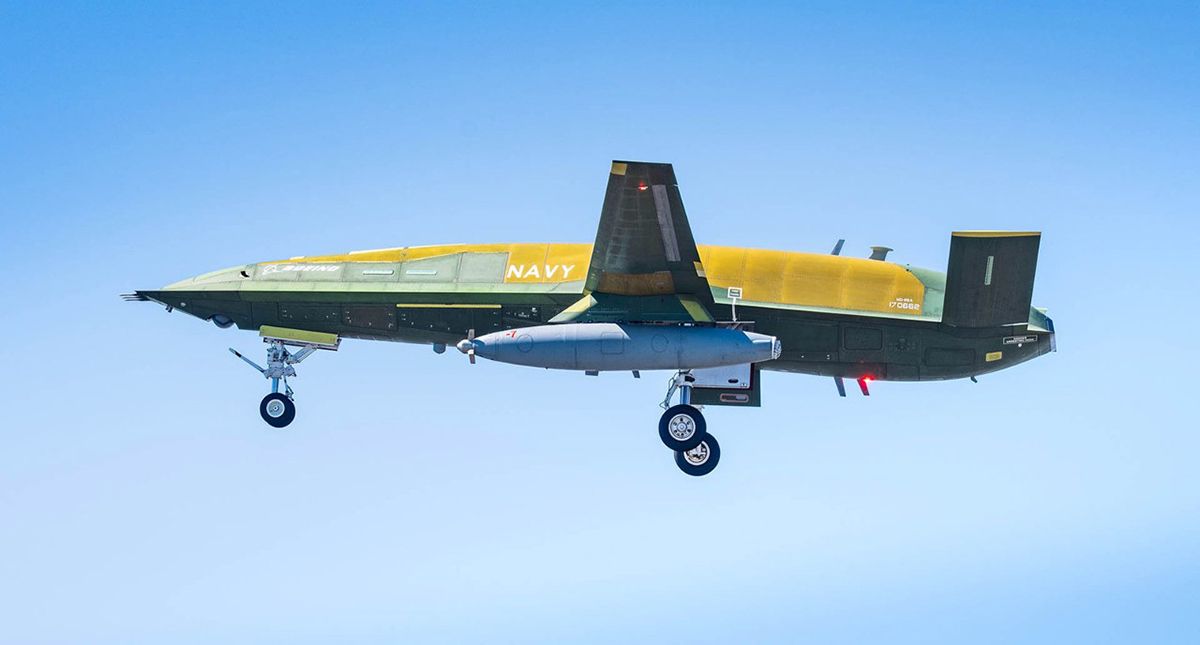
- Boeing receives $12.68 million investment to update the MQ-25's RF blanker, encrypted storage, and mission computer security, running through November 2029
- The change is a recent one: the Navy's April 2026 acquisition report lists refueling as the MQ-25's primary mission and intelligence, surveillance, and reconnaissance (ISR) as secondary, with no electronic warfare requirement and only two key performance parameters
- An RF blanker is electromagnetic compatibility hardware that stops an aircraft's own transmitters from deafening its receivers, allowing it to conduct EW more effectively
A single line buried in a recent US Department of War contract announcement is being read across multiple channels as the Navy's first carrier-based drone acquiring multiple electronic warfare upgrades.
The details, however, seem to focus on the defensive side of the spectrum and include a Radio Frequency Blanker Unit and an updated Encrypted Mass Storage System carrying an embedded Data Transfer System.
The modification also provides an option for deficiency analysis and corrections, supporting security assessments of the aircraft's Mission Management System Computer.
Why do these upgrades matter?
The most important upgrade for the MQ-25 Stingray, arguably, is its RF Blanker. An RF blanker is electromagnetic compatibility equipment. When an aircraft carries several transmitters and sensitive receivers within a few meters of each other, a transmitter firing at full power can deafen or damage a nearby receiver operating in an overlapping band.A blanker fixes that by taking a blanking request from each transmitter and issuing a suppression pulse to the affected receivers for the duration of the transmission, as GE Aerospace describes. For a drone that could also house sophisticated EW capabilities in the future, this is essentially a prerequisite.
The Navy's Modernized Selected Acquisition Report dated April 21, 2026, offers a relatively narrow scope for the drone for now; however, it states that the MQ-25 conducts aerial refueling as its primary mission and provides Intelligence, Surveillance, and Reconnaissance capability as a secondary mission.
It is fairly possible that the upgrades are purely defensive, to prevent rogue players from accessing the drone or knocking it offline with relative ease. In its current capacity, the MQ-25 serves as an unmanned aerial refueling drone for the US Navy, offering capabilities including the ability to carry roughly 14,000 to 16,000 pounds of fuel at a combat radius of 500 nautical miles.
This sudden investment may signal more to come: Boeing has already pitched a land-based MQ-25 variant with external pylons and marketing language about ISR, electronic warfare, and airborne early warning roles, though the aircraft has no customer yet.

Having built hundreds of gaming PCs and being an avid gamer in his spare time, Rahim tends to have stronger opinions about hardware than most. This is particularly on display when he gets his way with powerful, but minimalistic RGB builds even as Small Form Factor (SFF) PCs come a close second.