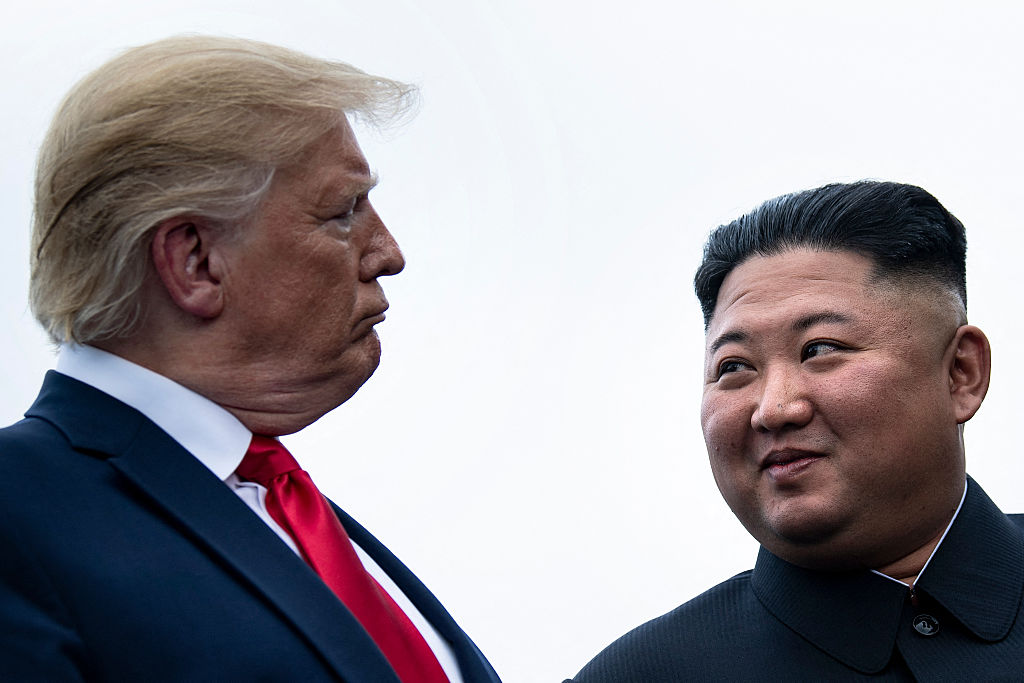
On the eve of the 10-day Ulchi Freedom Shield military drills —involving 18,000 South Korean troops alongside thousands of U.S. and U.N. forces—President Donald Trump dropped one of his trademark bombshells. Announcing he would “substantially reduce” American participation, Trump cited his “very good relationship with Kim Jong Un” and need to rebuke Seoul for refusing to join his war against Iran.
“These exercises are not only costly … but send a signal that is totally inappropriate and hostile to a country that, as long as Donald J. Trump has been president, has been unthreatening and respectful,” Trump posted on Truth Social.
In response, South Korea’s presidential Blue House said it remained in “close coordination" with Washington regarding the drills, which had begun as “previously notified and scheduled,” according to its defence ministry.
Still, the decision deals a severe blow to American alliance credibility. Reducing participation in exercises underpinning a 72-year mutual defense treaty with democratic South Korea, while Trump emphasizes his personal relationship with Kim, raises questions about the durability of U.S. security commitments in the Asia-Pacific. At the same time, it whitewashes a police state ranked 3/100 by rights group Freedom House—a regime whose sole formal treaty allies are primary U.S. adversaries China and Russia.
Furthermore, Trump’s assertion that Pyongyang has been “unthreatening and respectful” stands in contrast with North Korea’s continued military activity. Since Trump re-entered office, North Korea has conducted 24 ballistic missile tests—alongside numerous cruise missile and air-defense firings—including a launch just last Wednesday.
Pyongyang has also aggressively expanded its global military footprint following its June 2024 comprehensive strategic partnership with Moscow, dispatching more than 14,000 North Korean troops, artillery ammunition, and ballistic missiles to support Vladimir Putin’s war in Ukraine. (Ukrainian President Volodymyr Zelenskyy has warned that Kim is preparing to deploy 30,000 more.)
Trump’s criticism of South Korea for declining to help “denuclearize” Iran also sits uneasily alongside North Korea’s longstanding role in the development of Tehran’s strategic weapons programs. From a counter-proliferation perspective, North Korea presents a distinct challenge: unlike Iran, it already possesses an operational nuclear arsenal and has an extensive history of transferring missile and military technology abroad.
“The North Koreans provided Iran with technical assistance, building turnkey factories, technology design, production capabilities, tactics—those kinds of things,” says Daniel Pinkston, an international relations expert at Troy University in Seoul. “Technological agreements and high-level scientific visits go back years.”
During the 1980–1988 Iran–Iraq War, North Korea emerged as one of Tehran’s primary arms suppliers. That relationship deepened following the collapse of Soviet subsidies in the early 1990s, when Pyongyang bartered missile technology for Iranian crude oil to keep its depleted economy afloat.
Tehran purchased North Korean Scud-B and Scud-C missiles, using them as the blueprints for its own Shahab-1 and Shahab-2 ballistic missile programs. Later, North Korea’s Nodong-1 missile was adapted into the Shahab-3—the backbone of Iran’s modern long-range strike capabilities, including variants like the Emad and Ghadr. Declassified intelligence indicates Iran specifically modified the nose cones of its Shahab-3 missiles to accommodate miniaturized nuclear warheads.
North Korean military engineers—renowned for building massive subterranean installations—also helped Iran design and construct hardened missile silos, underground networks, and nuclear facility bunkers. Beyond missile architecture, Pyongyang supplied Iran with midget submarines, anti-ship missiles, rocket launchers, and specialized commando training.
While Western intelligence agencies have debated periodic reports of Iranian scientists attending North Korean nuclear tests, Pyongyang’s willingness to proliferate nuclear infrastructure elsewhere is beyond doubt. In 2007, an Israeli airstrike destroyed Syria’s covert Al-Kibar facility—a plutonium-producing reactor built by North Korea that was a carbon copy of its 5-megawatt reactor at Yongbyon.
Beyond diplomacy, scaling back joint drills carries immediate tactical consequences. South Korean and U.S. military commanders had planned to use the Ulchi Freedom Shield exercises to adapt to evolving battlefield tactics showcased by North Korean forces in Ukraine, including drone swarm integration, electronic GPS jamming, and coordinated cyber warfare.
“They’ve taken those lessons learned there and brought them back to North Korea—that changes their capability,” Col. Ryan Donald, public affairs director for U.S.-led commands in South Korea, told reporters. “That is why the exercise looks different and over the last five years has continually evolved.”
So why Trump’s sudden policy shift? On Saturday, the U.S. commander-in-chief shared a throwback photograph posing with Kim in 2019, reiterating that the two “get along great.” The post reignited speculation that Trump is eager to stage another high-profile summit with Kim to claim a foreign policy win. Observers note a similar transactional caution in Trump stalling on a $14 billion arms package for Taiwan—the largest ever—to avoid derailing Chinese President Xi Jinping’s upcoming state visit.
But Trump’s broadside against Seoul highlights a broader global trend: partners taking steps to insulate themselves from U.S. volatility. At the same time, the Iran war has in fact turned South Korea into a major defense supplier to Gulf nations like Saudi Arabia and the UAE, which are purchasing the Cheongung-II medium-range air defense system rather than relying exclusively on American military hardware.
From Europe to the Middle East, traditional U.S. allies are replacing strategic reliance with independent insurance policies. Denmark recently opted for a Franco-Italian air defense network over the U.S. Patriot system, while Canada is re-evaluating its commitments to the F-35 program. The Dutch Central Bank migrated critical cloud infrastructure away from American tech firms to European providers to minimize systemic vulnerability.
Perhaps most remarkable was the Aug. 7 signing of the Mecca Joint Defense Agreement—a NATO-style collective security pact between Saudi Arabia, Turkey, and Pakistan. After a decade of regional rivalry defined by clashes over the Muslim Brotherhood and the assassination of journalist Jamal Khashoggi, Riyadh and Ankara have found common ground amid growing questions about the extent to which they can rely on longstanding U.S. security commitments.
“It is incoherent nonsense,” says Pinkston of Trump’s flipflopping. “The credibility of the United States is under attack, and that is a direct threat to U.S. national security and international stability.”