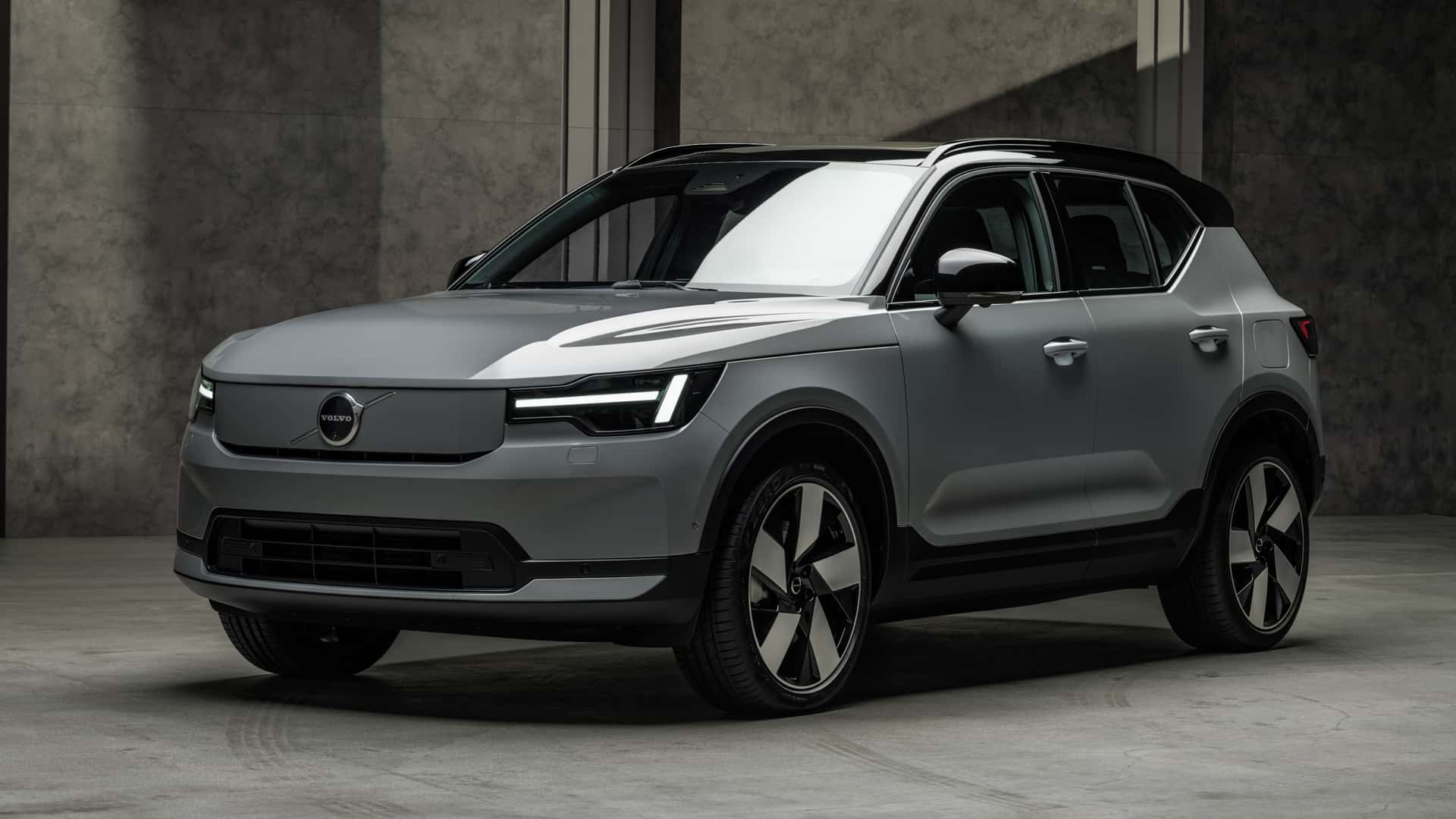
- Volvo is discontinuing yet another electric model from its American lineup.
- The EX40, initially known as the XC40 Recharge, has been retired stateside.
- Yet another facelift keeps the model alive in Europe and other markets, though.
In the U.S., the coupe-like EC40 was dropped after the 2025 model year, and now the EX40 is joining that list, which also includes the entry-level EX30. However, Volvo dealers won’t have to wait too long to get a fresh electric model, as the company is already working on a much more modern car that will replace all three discontinued EVs.
 The refreshed Volvo EX40 lives on in Europe with a slightly redesigned front fascia and a bigger infotainment screen.
Photo by: Volvo
The entry-level crossover is expected to arrive in the U.S. by the end of 2027 with a starting price below $50,000, which is not exactly cheap. That said, it will still be cheaper than the 2026 EX40, which starts at over $56,000.
Over in Europe, the aging EX40 and EC40 are getting a modest exterior redesign, with new LED lights front and rear, redesigned bumpers, a new tailgate for the EX40, and an updated front grille.
Volvo EX40 (2026)
Photo by: Volvo
On the safety side, the cars get new front and corner radars, a new front camera, new corner radars, 12 new ultrasonic sensors, and new parking cameras. All of these features are part of a new software and sensor platform that enables several new and upgraded safety functions, including a Door Opening Alert that warns occupants of cyclists and other road users before opening the door into passing traffic.
The optional Pilot Assist feature can now do lane changes and follow the car in front more smoothly, while the available 360-degree camera adds a 3D view that should make parking a little easier.
All of these improvements are also coming to the gas-powered , which is going to be sold in the U.S.
Under the skin, the refreshed EX40 is available with either rear-wheel drive or dual-motor all-wheel drive, and a selection of three battery packs that don’t make much sense.
Gallery: Volvo EX40 (2026)
The P4 Long Range, P5 Long Range, P8 AWD, and P8 Performance AWD get a 79-kilowatt-hour (usable) pack that can be fast-charged at up to 205 kilowatts. Then, there’s the P5, which has two battery options: a 66 kWh pack that accepts up to 135 kW, and a 67 kWh version that can take in up to 180 kW.
The shortest-range model is the one with the smallest-capacity battery, which can travel between 270 and 292 miles (435-471 kilometers) on a full charge on the WLTP combined cycle. The longest-range model is the P5 Long Range, which maxes out at 356 miles (576 km) on the WLTP cycle.