Published on
Industry data shows it was the most disruptive month for Russian civil aviation since its full-scale invasion of Ukraine began in early 2022.
Figures from aviation security firm Osprey Flight Solutions state that restrictions were imposed at 32 airports in August, including Moscow and St Petersburg.
Over the summer as a whole, 2,182 closures were recorded — already exceeding the full-year total for 2025.
The Insider, an investigative Russian outlet, calculated that the August closures reached more than six times the 2025 monthly average.
Ukrainian President Volodymyr Zelenskyy warned airlines and insurers on 1 September that Russian airspace "is becoming completely unsafe" for civil aviation.
"We in Ukraine do not want innocent lives to be lost. That's why we are warning our partners: the days of safety in Russia's skies are over," Zelenskyy said.
Andriy Zagorodnyuk, a former Ukrainian defence minister, said the goal was not to attack civilian aircraft but to create lasting uncertainty.
"Ukraine is not seeking to shoot down civilian aircraft, but it is making Russia's skies unsafe for flying," he said in last week's comments to Ukrainska Pravda.
The trigger for airport closures is the activation of what Russia calls the "Kover" — Russian for "carpet" — protocol, an air defence procedure designed for rare emergencies that grounds or redirects all civil aircraft when a drone threat is detected in the area.
Military analyst Mykhailo Samus, of the Centre for Army, Conversion and Disarmament Studies, said airport closures were part of a broader strategy of economic exhaustion, alongside rising insurance premiums, the withdrawal of foreign carriers and reduced domestic mobility.
"Airport closures are the new reality for Russian aviation," he said.
'Impossible to take off or land'
Russia's Transport Minister Andrey Nikitin said no significant disruptions to civil aviation would be allowed, yet operational data contradict his statement.In the first three days of September, an average of 86 flights per day were cancelled in Russia, according to FlightRadar24 — a level comparable to August's worst periods.
On the most severe nights around Moscow, between 77 and more than 100 flights were delayed or cancelled in a single overnight period.
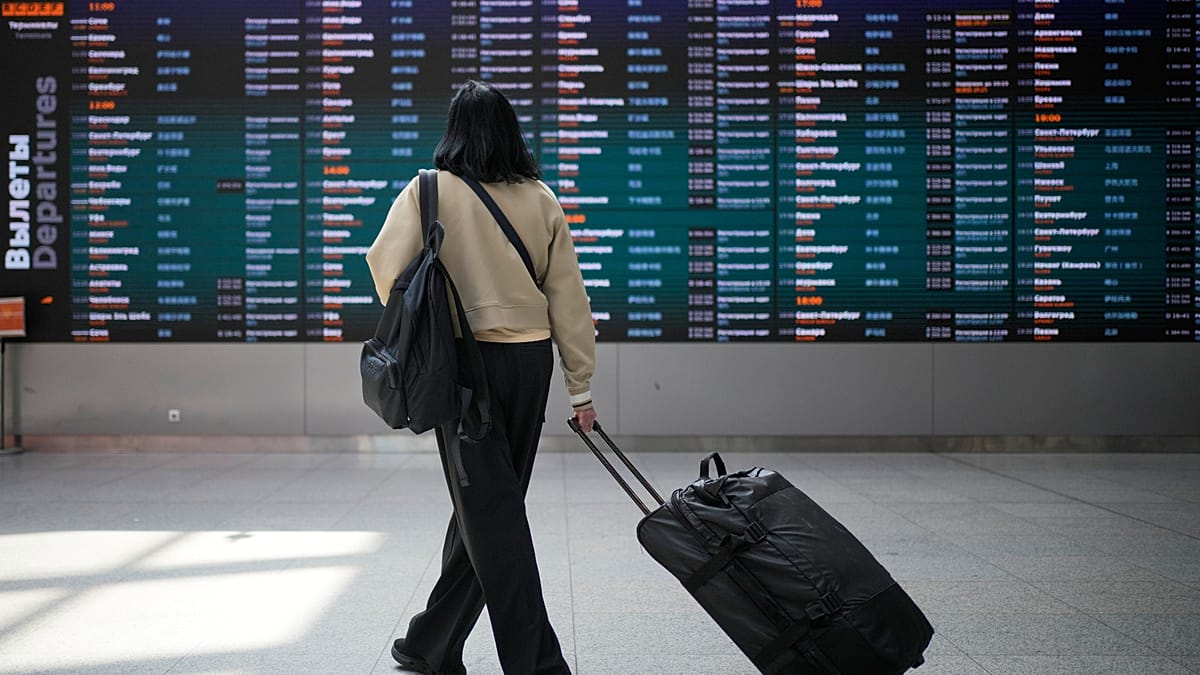
Passengers have documented the disruption in detail on social media and in regional news feeds.
"We've been sitting on the plane for an hour, Vnukovo has been closed, nobody is explaining anything," one traveller wrote on Telegram.
"Pulkovo won't let the flight depart, Moscow won't receive it. " another posted. A third passenger said, "The online board is all red, it's impossible to take off or land. "
Some foreign carriers that had continued to fly to Russia after the full-scale invasion have since adjusted routes or suspended operations.
Changes have affected Pegasus, Flydubai and Air India, according to industry media.
Passenger numbers on the Moscow-St Petersburg route have fallen by 20-23%, while rail demand has risen by roughly 20% in response.
The investigative outlet Agentstvo has noted that the aviation disruption overlaps with pressure on other parts of the Russian economy, including declining oil refining capacity, higher logistics costs and interruptions to warehouse operations caused by Ukrainian drone strikes on industrial facilities.