
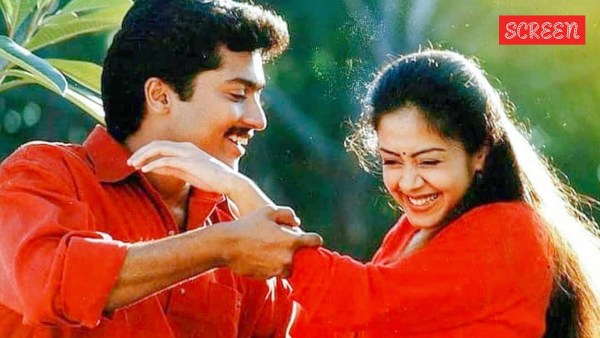
 Suriya and Jyotika in Sillunu Oru Kaadhal, which released three days before the couple married in 2006.
Twenty years ago today, a Tamil romance about an arranged marriage that slowly turns into real love opened in theatres across Tamil Nadu. Three days later, on September 11, the two actors who played the married couple, Suriya and Jyotika, got married in real life. The film was Sillunu Oru Kaadhal. What followed after the film release is a marriage that lasted two decades, two children and a combined filmography that has shaped Tamil cinema. The film, against all commercial logic, has lasted just as long.
What is Sillunu Oru Kaadhal about
Sillunu Oru Kaadhal, which translates to “A Breezy Love,” was directed by N Krishna and starred Suriya as Gowtham, Jyotika as Kundavi and Bhumika Chawla as Aishwarya.
The story follows Gowtham and Kundavi, who marry through an arranged match in the small town of Ambasamudram in Tirunelveli district. Neither of them were happy about it. Six years later, they are living in Mumbai with a young daughter and are deeply in love. The crisis arrives when Kundavi discovers Gowtham’s old college diary and learns about his past relationship with Aishwarya. Rather than confronting him, she quietly arranges for the two to meet again, believing he would rather be with his first love.
The film was originally titled Jillunu Oru Kadhal before being changed to Sillunu Oru Kadhal to use a pure Tamil word. Interestingly, Vijay was initially cast in the lead before the role went to Suriya. No official reason was given for the change, but the switch proved decisive. With Suriya and Jyotika playing a married couple while their own real-life wedding was days away, the film carried an emotional weight that a different casting combination could not have replicated.
Also Read: ‘It is only right’: How Jyotika’s ageing parents prompted Suriya to shift home base to Mumbai
In an interview with Ananda Vikatan, Bhumika Chawla revealed that director N Krishna initially offered her the role of Kundavi, the wife, the part that eventually went to Jyotika. Bhumika turned it down and chose instead to play Aishwarya, the college love interest. She said the character had two distinct shades in the film and was far more challenging as a performer. “The character I played had two different shades and was very challenging. That was the reason I opted for it,” Bhumika said, adding that she signed the project specifically for that role.
Before Bhumika accepted the role, it was offered to Asin, who was one of Tamil cinema’s biggest names at the time following the success of Ghajini with Suriya. Asin declined, reportedly feeling the role did not have enough scope. The director also offered her three songs in the film as an incentive but she turned those down as well.
Story continues below this ad
The real-life love story
Suriya and Jyotika first met on the sets of Poovellam Kettuppar, directed by Vasanth. It was one of Jyotika’s earliest Tamil films. She had moved from Mumbai and was still struggling with the language. Suriya helped her feel comfortable with Tamil dialogue on set, and the two became close friends during the shoot.
But it was not Poovellam Kettuppar that turned friendship into love. That happened four years later, during the making of Gautham Vasudev Menon’s Kaakha Kaakha. It was Jyotika who had recommended Suriya’s name to Menon for the film after being impressed by his performance in Nandha. During the shoot of Kaakha Kaakha, the two fell in love, and eventually the subject of marriage came up.
 Suriya and Jyotika on the sets of Poovellam Kettuppar.
However, it was not a smooth path to the altar. Suriya’s father, veteran actor Sivakumar, was initially opposed to the match. The objection stemmed from cultural differences. Jyotika, born Jyotika Sadanah, comes from a Punjabi-speaking family in Mumbai. The Sivakumar family is rooted in Tamil culture and tradition. The gap between the two backgrounds was enough to give the patriarch pause.
Suriya, however, was not willing to negotiate. In a Galatta interview, Sivakumar recalled his son’s resolve. “Initially, I didn’t accept his love. However, he was very adamant and said that he would only live with her; otherwise, he would remain single for life,” Sivakumar said. The ultimatum forced the veteran actor to reconsider. “Then I thought about how, over the course of my career, I acted in around 150 films, and most of them were around the idea of love marriages. So I finally agreed,” he said.
Story continues below this ad
On September 11, 2006, three days after Sillunu Oru Kaadhal opened in theatres, Suriya and Jyotika married at the Park Sheraton Hotel in Chennai. The wedding was attended by family and friends from the industry, including Sivakumar, who had by then fully accepted the match. The couple eventually had two children, daughter Diya, born in 2007, and son Dev, born in 2010.
Playing husband and wife while becoming husband and wife
The casting created an emotional overlap that no screenplay could have manufactured. Suriya and Jyotika were not yet married when they filmed the wedding scene in Sillunu Oru Kaadhal. They were playing a couple whose arranged marriage slowly, over years, turns into genuine love. They were doing this while their own relationship, which had started on a film set seven years earlier, was heading toward its own wedding.
The scenes between Suriya and Jyotika in the Mumbai portions of the film carry a warmth that goes beyond what the script provides. Their domestic sequences, the meals, the small arguments, the way she adjusts his collar before he leaves for work, the way he watches her play with their daughter, feel lived-in rather than performed. These are two people who know each other deeply, who are comfortable in each other’s space, who do not need to act the intimacy because it is already there.
Story continues below this ad
What makes their love story beautiful is that the timing of September 8 and September 11, 2006 was never planned. The film’s release date was set by the producer and the wedding date was set by the families. The three-day gap was a merely just a coincidence. But it gave the film something no marketing budget could have bought: a real ending that happened off screen, with the same two people who had just played it on screen in a theatre.