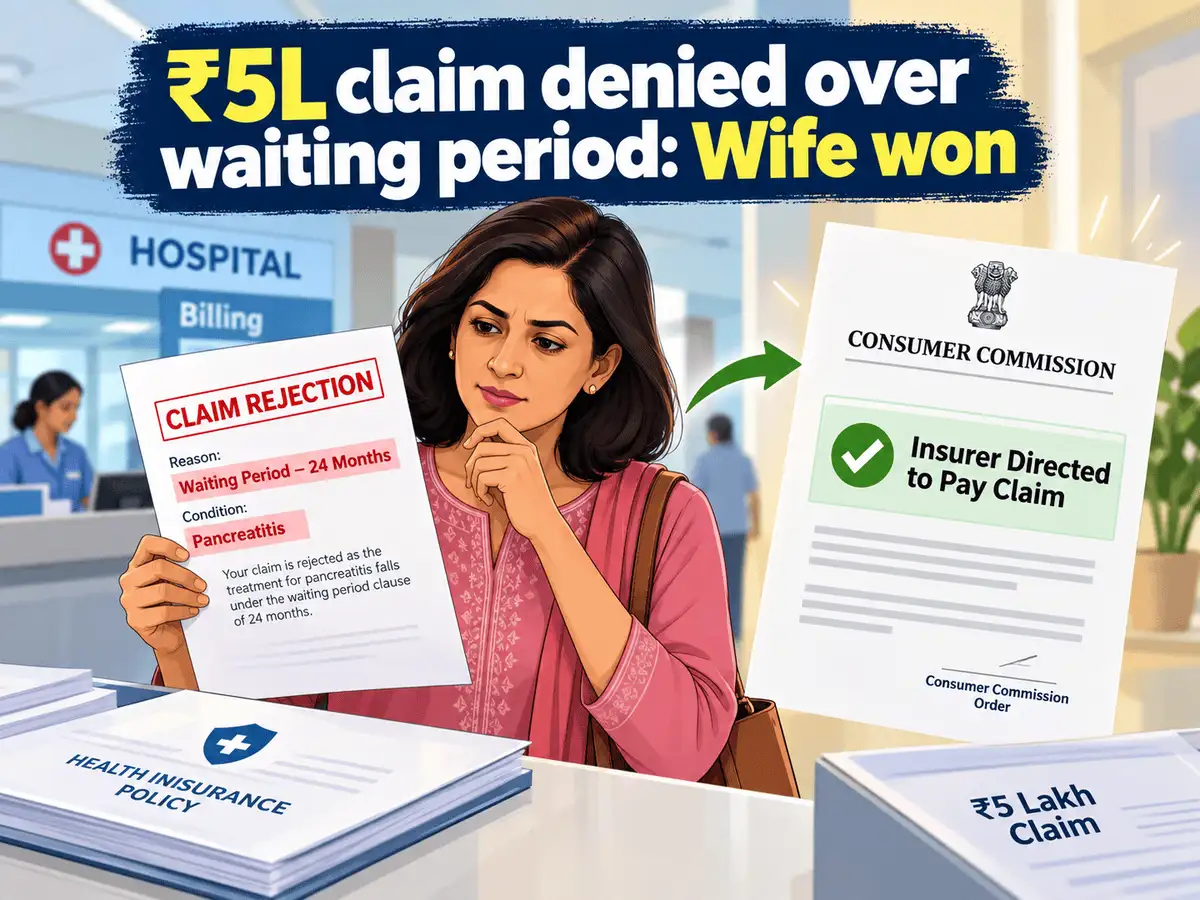
A health insurer cannot mechanically rely on a waiting-period clause to reject a claim when it fails to establish that the insured's condition was pre-existing, the Mumbai Suburban District Consumer Disputes Redressal Commission has held in a case involving a ₹5 lakh pancreatitis claim.
The commission directed Max Bupa Health Insurance Co. Ltd., currently known as Niva Bupa Health Insurance Co. Ltd., to pay the policyholder's ₹5 lakh claim after the insurer rejected it, citing a 24-month specific waiting period for pancreatitis.
The case highlights an important issue for health insurance policyholders: a waiting period in the policy does not necessarily settle whether a particular claim can be rejected; the insurer may still have to establish that the clause applies to the facts of the case.
Why did the health insurer reject the Rs 5 lakh claim?
The deceased was insured under Max Bupa's Health Companion Variant 2 policy, which was initially taken in October 2017 for a sum insured of Rs 5 lakh and renewed in October 2018. His wife was the complainant in the case.
The complainant’s husband was suddenly hospitalised with severe abdominal pain and was diagnosed with acute pancreatitis during treatment. Unfortunately, he passed away on 7 February 2019 due to acute pancreatitis with multiple organ failure.
The family incurred Rs 1.94 lakh at Criticare Hospital and Rs 4.15 lakh at Lilavati Hospital. Although the policy was cashless, the complainant paid the hospital bills by borrowing money from relatives, expecting reimbursement after the claim was processed.
The family submitted two claims in March 2019. Max Bupa subsequently rejected the claims, relying on Clause 5.3 of the policy, which prescribed a 24-month specific waiting period for certain medical conditions, including pancreatitis.
“The insurance company rejected the claim by relying upon Clause 5.3 of the policy, which prescribed a specific waiting period of 24 months for certain diseases, which included pancreatitis. Since the illness in this case had occurred before completion of 24 months from the commencement of the policy, the insurer took the position that the claim was excluded,” says Advocate Mayank Arora, Partner, The Chambers of Bharat Chugh.
What did the policy's 24-month waiting period say?
Clause 5.3 provided that certain listed medical conditions and surgical treatments would be subject to a 24-month waiting period, unless the condition was directly caused by cancer or an accident. Pancreatitis and stones in the biliary and urinary system were specifically listed under the clause.
The insurer argued that this waiting period was part of the agreed policy terms and conditions. It also said the policy documents had been provided to the policyholder, who had a 15-day free-look period to review the terms and cancel the policy if required.
The policy wording stated that these conditions would be covered in the third policy year, provided the insured had remained continuously insured under the policy without a break. Pancreatitis was specifically included in the list of conditions subject to the 24-month waiting period.
The question before the commission was therefore whether the 24-month waiting period could be used to reject a claim arising from acute pancreatitis that had not been shown to exist before the policy was taken.
What did the consumer commission say?
The commission examined the purpose behind a waiting-period clause and observed that such clauses are essentially intended to prevent a person from purchasing insurance after a disease has already been detected, or when the patient is already symptomatic, purchases the policy only to make a claim for such a disease.
“In other words, the object is to guard against adverse selection and pre-existing or known medical conditions,” says Arora.
According to Saloni Shah, Founding Partner, Khanwilkar & Shah Associates, the primary observations by the Commission were:
* There was no evidence of pre-existing pancreatitis. The policy covered the insured from October 2017, and he developed acute pancreatitis only in January 2019. The Commission noted that neither party had alleged any pre-existing pancreatitis and, importantly, the insurer failed to produce evidence establishing that the disease existed before the policy.
* The waiting-period clause was intended to address pre-existing conditions, not a disease arising unexpectedly during the policy.
* The medical evidence supported the policyholder. The treating doctor certified that the pancreatitis was a rare case with no apparent cause.
* The insurer's reliance on the 15-day free-look period did not help. This is important as the Commission rejected the argument that the policyholder should have understood and objected to the waiting-period clause during the free-look period. It observed that an ordinary policyholder cannot be expected to understand the medical and legal implications of an exclusion clause in the context of an unforeseen emergency.
* The Commission applied a fairness-oriented interpretation of the insurance contract. It characterised the repudiation as “hyper technical” and held that insurance policies should be construed to promote fairness and justice rather than defeat legitimate coverage.
* There was also a separate concern regarding the cashless assurance. Although the policy was cashless, the insurer made the complainant pay approximately Rs. 6.10 lakh towards hospital expenses and, after she incurred those expenses on the assurance of reimbursement, subsequently repudiated the claim.
The commission therefore held that the repudiation amounted to deficiency in service and unfair trade practice.
ET Wealth Online has approached Max Bupa for its response and inputs on the matter. The insurer's response was awaited at the time of publication.
Does this mean an insurer cannot reject a claim during a waiting period?
The ruling does not mean that every claim arising during a waiting period must be paid.
Rather, the commission examined whether the particular waiting-period clause was correctly applied to the facts of this case. It found that there was no evidence of pre-existing pancreatitis and that the medical evidence indicated that the condition manifested unexpectedly during the policy period.
“This ruling makes it clear that insurers cannot rely on rigid technical clauses to deny coverage when policyholders are confronted with unforeseen, life-threatening medical emergencies. Insurance policies must be interpreted to uphold fairness and consumer protection, not to frustrate genuine claims,” says Kavita Brid Chavan, Partner, Rajani Associates.
However, policyholders should not interpret the ruling as meaning that a waiting-period clause has no effect. The exact wording of the policy, the nature of the illness, medical history and evidence available in the case can all matter.
How much did Max Bupa have to pay?
The Mumbai Suburban District Consumer Disputes Redressal Commission partly allowed the complaint and held the insurer guilty of deficiency in service and unfair trade practice.
“The insurer was directed to pay Rs 5 lakh with 6% interest, Rs 50,000 as compensation and Rs 10,000 towards litigation costs to the Complainant,” says Arora.
The family had actually incurred ₹6.09 lakh in hospital expenses. However, the policy's sum insured was ₹5 lakh, so the Commission awarded ₹5 lakh towards the claim.
What does this ruling mean for health insurance policyholders?
The case highlights the importance of understanding waiting periods, exclusions and the circumstances in which they apply before buying a health insurance policy.
There is an important distinction between a disease that was already existing, diagnosed or being treated when the policy was purchased and on the other hand, a completely unforeseen disease that manifests itself for the first time during the currency of the policy.
The case does not mean that waiting-period clauses are invalid or that every claim arising during a waiting period must be paid. Rather, the commission examined whether the insurer had correctly applied the particular waiting-period clause to the facts of the case.
“Policyholders should not assume that repudiation by an insurance company is final. A repudiation letter represents the insurer's interpretation of the policy; it is not necessarily the final legal position. Consumer commissions can examine whether the exclusion has been applied fairly, whether there is medical evidence supporting repudiation, and whether the insurer's conduct amounts to a deficiency in service,” says Arora
For policyholders, the practical lesson is to read the waiting-period clause carefully, disclose medical history accurately and retain hospital and medical records. If a claim is rejected, the policyholder should examine the precise clause cited by the insurer and the medical basis for the rejection.