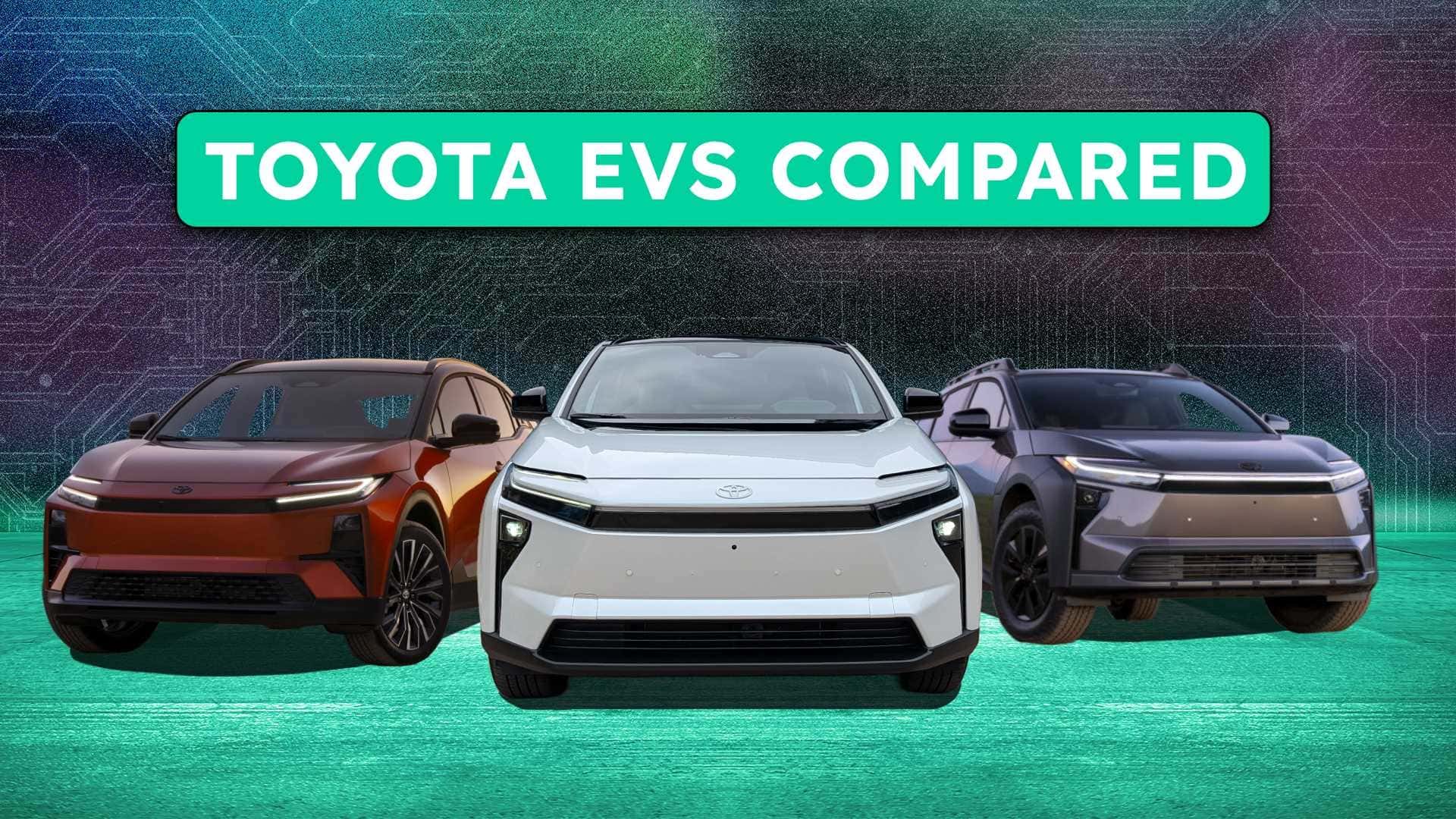
Toyota's EV timing has been a bit counterintuitive. When electric car sales were booming and the federal tax credit sweetened the deal, the automaker crawled through the transition with just one so-so model, the bZ4x. Now that the incentive is gone and EV sales have cooled, Toyota suddenly has three new or refreshed models to sell, plus more on the way.
The strategy is working. In the first quarter of this year, the bZ was America's best-selling non-Tesla EV, thanks to big range and charging improvements. It's also no longer the automaker's sole battery-powered model, now joined by the smaller C-HR and the wagon-like bZ Woodland. The broader lineup helped push Toyota's U.S. EV sales up 225% in the second quarter.
The Toyota-faithful now have more capable electric options to choose from than ever before. But which should you pick?
 2026 Toyota bZ Woodland
2026 Toyota C-HR
2026 Toyota bZ
2026 Toyota bZ Woodland
2026 Toyota C-HR
2026 Toyota bZ
Photos by: Suvrat Kothari
Buyer needs will obviously differ, so let's break down the key differences to help you find the right fit. My pick of the bunch is the all-wheel-drive bZ XLE, and I'll explain why as we go.
Toyota bZ, bZ Woodland, & C-HR: Pricing & Basics
The three EVs share underlying technology but cater toward slightly different buyers. The bZ leans toward value in the hot crossover segment. It's a direct competitor to popular EVs like the Tesla Model Y and Hyundai Ioniq 5. The C-HR is compact, with a slightly sportier feel. The bZ Woodland is the biggest and most adventure-oriented of the bunch.Base pricing, including destination charges, is as follows: $36,495 for the bZ, $38,695 for the C-HR, and $46,975 for the bZ Woodland.
Toyota EV Range: bZ, bZ Woodland, & C-HR Compared
Underneath, all three EVs are very similar. They’re manufactured in Japan on the same e-TNGA platform which is now more capable than the pre-rebrand bZ4x.All share the same 74.7-kilowatt-hour nickel manganese cobalt (NMC) battery. The bZ delivers up to 314 miles of EPA-rated range, the C-HR is good for 287 miles, and the bZ Woodland tops out at 280 miles. The entry-level bZ also offers a smaller 57.7-kWh battery good for 236 miles.
| Toyota bZ | Toyota C-HR | Toyota bZ Woodland | |
| Starting price, with destination | $36,495 | $38,675 | $46,975 |
| EPA Range | 236-314 miles | 287 miles | 280 miles (260 on all-terrain tires) |
| Battery | 74.7 kWh (57.7 kWh on base) | 74.7 kWh | 74.7 kWh |
| Charging 10-80% | Under 30 mins | Under 30 mins | Under 30 mins |
| Drivetrain | FWD or AWD | AWD | AWD |
| Horsepower | 165 (base), 221 (FWD, large battery), 338 (AWD) | 338 hp | 375 hp |
| Cargo space (cu-ft) | 27.7 | 25.3 | 33.8 |
| Ground clearance inches | 8.1 | 8.0 | 8.4 |
Efficiency & Charging Speed
The good news is, unlike the old bZ4x, model year 2026 and 2027 Toyota EVs get upgraded batteries and drive motors that make them more efficient in the real world. I observed well over 3.0 miles per kilowatt-hour on all three EVs in mixed city and highway driving. In the city, the C-HR and bZ Woodland even touched 5.0 miles per kWh over short distances before settling into the 3.5 to 4.0 mile-per-kWh range on longer drives and highway stretches.Take those efficiency numbers with a grain of salt, though. I did most of my driving in summer conditions when battery cells are at their happiest. In colder weather here in the Northeast, we saw a maximum of 2.7 miles per kWh on the bZ during a in upstate New York. Your own numbers will vary depending on climate, driving style, road conditions, and more.
Charging speeds are consistent among the three EVs. According to Toyota, they all charge from 10% to 80% in roughly 30 minutes, a big improvement over the old bZ4x, which took nearly an hour to do the same.
2026 Toyota C-HR charging at an Ionna station in Pennsylvania.
Photos by: Suvrat Kothari
2026 Toyota bZ Woodland charging at an Ionna station in New Jersey.
All three support Plug & Charge at select networks through the Toyota app, though you'll want to read the fine print to see exactly which networks qualify. Toyota has on its website to help you navigate that.
Toyota EVs: How Do They Drive?
The C-HR is the most fun to drive of the three. Standard all-wheel drive and 338 horsepower launches it to 60 miles per hour in a claimed 4.9 seconds, and it accelerates with puppy-dog energy. Switch off traction control and stomp the pedal, and you'll feel the front tires momentarily break loose like a hot hatch. It also stays planted in corners with minimal body roll.The 338 hp, all-wheel-drive bZ is no slouch either, with strong off-the-line performance. The 221 hp, front-wheel-drive trim also felt plenty quick in our limited testing last year, and this is the version with over 300 miles of range. If you want to maximize fun though, you'll want the AWD.
Photo by: Suvrat Kothari
However, its extra length and weight shows up in corners, with slightly more noticeable body roll over the other two EVs here. The bZ Woodland's 4,497-pound curb weight is 131 pounds more than the C-HR and 264 pounds more than the bZ. It's also more than a foot longer than the C-HR and 5.6 inches longer than the bZ.
But it's not a dealbreaker at all. That extra size pays off in interior space and cargo room (more on that below). And the e-TNGA platform delivers pretty solid chassis dynamics across the Toyota, Lexus, and Subaru lineup. EVs built on it don't feel nearly as porky as, say, GM's Ultium-based crossovers like the Chevy Equinox EV and Blazer EV.
2026 Toyota bZ Woodland
Photo by: Suvrat Kothari
What the C-HR and bZ do share is a tendency toward loud, clunky thuds over expansion joints, which makes the ride feel a touch unrefined. Then again, it's more pronounced on bad roads. If the pavement where you live is in better shape, you'll likely notice it less than I did.
Purely in terms of ride quality and overall performance, the bZ Woodland was my favorite. With longer suspension travel, all-terrain tires with thick sidewalls, and 8.4 inches of ground clearance, you can bulldoze through bad roads without slowing down. The spring rate and damping are excellent too, soaking up bumps easily. And the side-to-side jolts are far less pronounced on the bZ Woodland compared to its siblings.
Photo by: Suvrat Kothari
The bZ AWD also gets the X-Mode setting with the exact same drive modes as the bZ Woodland. So the wagon's advantage is really narrow here, coming down to the extra ground clearance, all-terrain tires, and the extra room inside. I was able to tackle some pretty serious trails on the Subaru Solterra—the bZ's mechanical twin—in Colorado last year, and came away impressed with it.
Interior And Technology
The dashboards across all three EVs are practically indistinguishable. Each gets the same standard 14-inch touchscreen with wireless Android Auto and Apple CarPlay, the same steering wheel, the same digital gauge cluster, the same rotary gear knob, and an identical overall cabin design.
2026 Toyota bZ Woodland interior
Photo by: Suvrat Kothari
While the infotainment generally work well, the bZ Woodland randomly refused to play music via Bluetooth or connect to wireless Android Auto on a few occasions. Embarrassingly, I ended up doing an hour-long drive with my buddies without our favorite music, and had to fall back on Google Maps on my phone since the car's native navigation suggested a different, longer route.
These EVs run Toyota's older-generation software. None of them get the company’s latest which you'll find in the new RAV4 and the Lexus ES. Arene brings a slicker, more responsive touchscreen, customizable widgets, over-the-air updates for both ADAS, and infotainment, a built-in dashcam, and more.
A Toyota spokesperson that the bZ, C-HR, and bZ Woodland lack the hardware and software architecture needed to support Arene, meaning they'll likely need a major model-year update before they can get it.
The gauge cluster on the Toyota EVs gets blocked by the top of the steering, a persistent issue ever since the first bZ4x rolled out in 2022.
Photo by: Suvrat Kothari The three EVs also share another common problem, one that's persisted since the bZ4x's debut in 2022. The digital gauge cluster is pushed way back towards the windshield. The result is that, for many drivers (including myself) it's blocked by the top of the steering wheel. So key information like range and speed isn't easily visible without bobbing my neck up and down like an ostrich. I like a low, tucked in driving position, and the gauge cluster's positioning is especially unfriendly to that. Many people find it a non-issue, but I hope Toyota rethinks it in a future update.
In terms of cabin space, the bZ Woodland the roomiest of the three, which comes as no surprise given it's also the largest. It has the most spacious back seat and 33.8 cubic feet of cargo space behind it, well ahead of the bZ's 27.7 cu-ft and the C-HR's 25.3 cu-ft. The bZ is plenty roomy too, with ample head- and shoulder room for tall adults in the back. I’m 5'7" and didn't have any issues in the C-HR, but taller adults will find its rear seat cramped, with noticeably less legroom and headroom.
2026 Toyota bZ Woodland
2026 Toyota C-HR
2026 Toyota bZ
Photos by: Suvrat Kothari
Verdict
None of these three EVs are class leading, but they're good enough for the average EV buyer. Paired with Toyota's brand reputation, "good enough" might be a sensible short-term play until EV demand rebounds in the U.S. and competition meaningfully grows.The C-HR’s stiffer ride and higher starting price than the roomier bZ make it a dealbreaker for me. If money were no object, the bZ Woodland would take the win. It has the best ride quality, the most charming design, and tons of room inside. But it's also $10,000 more expensive than the bZ.
Which is why the bZ ends up as the value pick here. The XLE front-wheel-drive plus trim, with the larger battery, delivers 314 miles of EPA range and costs nearly the same as the base C-HR. Going all-wheel drive adds another couple grand but will give you a lot more oomph from behind the wheel—338 hp—and the same off-road settings as the bZ Woodland.
2026 Toyota bZ
2026 Toyota C-HR
Photos by: Suvrat Kothari
If you want something fancier, the more premium Lexus RZ and ES are worth a look, and we've reviewed both here at . Note also that Subaru also offers near-identical versions with the Solterra, Uncharted, and Trailseeker with a few minor trim-level differences. Want something bigger? Toyota will launch the three-row Highlander EV early next year.