NewsFree365
--°
Breaking
3 views

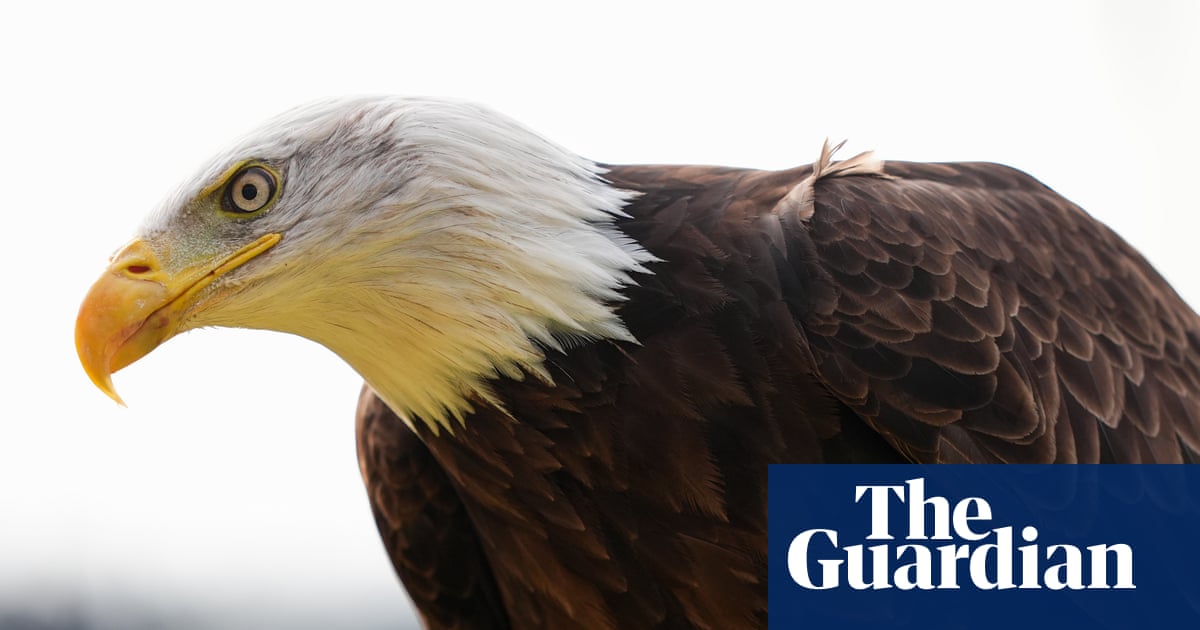
Canada saved the bald eagle from near extinction in the US – does the White House know?

The White House posted a photo of bald eagle attacking a Canada goose – but it was Canada that played a critical role in the recovery of the raptor in the US

Canada saved the bald eagle from near extinction in the US – does the White House know?
In late August, the White House posted a real photograph on social media of a bald eagle standing atop the limp neck of a Canada goose.

The raptor presses the goose’s face into the grey winter slush. With its stark white head and brilliant yellow talons, the eagle looks victorious and defiant.

As trade talks failed and tensions between Canada and the US rose, the image, viewed millions of times, apparently proved irresistible to the social media handlers at the White House for sending a clear message: the United States could not be challenged by Canada.

But experts say the bald eagle, long prized by Americans as a symbol even before becoming the country’s national bird in 2024, came perilously close to disappearing from much of the country – and that it was neighbouring Canada that played a critical role in its recovery, even going as far as to fly juvenile eagles south by plane to return them to US skies.

As many as half a million bald eagles once thrived before the European settlement of North America, near large bodies of open water, where they feasted on the abundant fish and nested in towering trees.
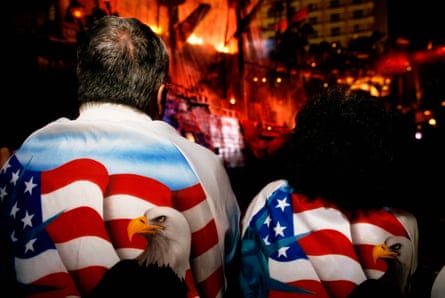
Couple wearing patriotic jackets.
Couple wearing patriotic jackets with an image of bald eagle. Photograph: Mark Peterson/Corbis/Getty Images
The eagle’s hulking, majestic presence left an imprint on the founders of the modern United States, who placed the bird on the Great Seal of the United States in 1782. (The use of the word “bald” doesn’t not mean hairless. Instead, it comes derives from the Middle English word ‘balde’ or ‘balled’ which means marked by a white blaze)

But crisis struck, as rapidly expanding settlements put eagles on a collision course with humans. “Bald eagles were seen by some as competitors for fish resources and a threat to their livestock and wild game by others,” said David Bird, a professor emeritus of wildlife biology at McGill University in Montreal. “None of those things turned out to be true in the end.”

Officials initially offered 50 cents for a pair of eagle feet, later raising the bounty to $2 by 1949. More than 100,000 bald eagles were killed under the bounty program until it was discontinued in 1953.
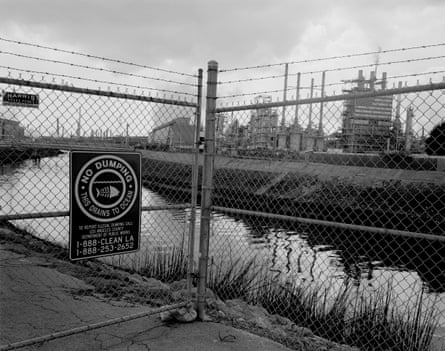
Industrial factories sit alongside a canal leading directly into the nearby Pacific Ocean in Torrance, Calfornia
Industrial factories alongside a canal leading directly into the nearby Pacific Ocean in Torrance, California. A nearby chemical factory producing DDT in the 1970’s, which has now been torn down, polluted a large area of the Pacific. It is estimated that sea birds and mammals will be affected by the DDT for hundreds of years. Photograph: Andrew Lichtenstein/Corbis/Getty Images
Meanwhile, a synthetic chemical compound was having an unexpected effect on wildlife. DDT, first produced on a large scale to combat malaria and then widely applied after the second world war to fight pests, was accumulating in the fatty tissues of animals – particularly in predators at the top of the food chain. In birds of prey, the result was devastating: eggshells became so thin and brittle that many eggs broke before they could hatch. The effects inspired Rachel Carson’s Silent Spring, the 1962 book that helped catalyse the modern environmental movement.

“If we are going to live so intimately with these chemicals eating and drinking them, taking them into the very marrow of our bones – we had better know something about their nature and their power,” she wrote. The pesticide was eventually banned in 1972.

Bird said the “the double whammy” of bounties and reproductive collapse put immense pressure on bald eagles. In 1963, only 417 breeding pairs remained in the lower 48 states.

Desperate biologists and officials turned to Canada. While DDT had ravaged much of the population in the US, the pesticide had been used less extensively north of the border.
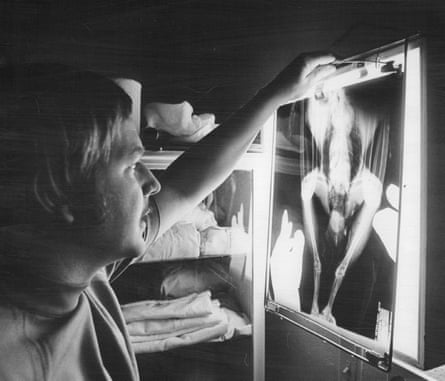
Dr Furcolow examines the X-ray of the bald eagle in 1972. He found buckshot, buckshot wounds and indicators of lung disease.
Dr Furcolow examines the X-ray of a bald eagle in 1972. He found buckshot, buckshot wounds and indicators of lung disease. Photograph: Denver Post/Getty Images
A 1983 media report profiled Operation Eaglet, a complex logistical effort that required cars, float planes and biologists in order to help repopulate the US. The CBC reporter called the effort a “courtesy of Canadian goodwill”. In one instance, the team collected eight baby eagles from the northern Manitoba, where experts believed roughly 3,000 birds remained, and sent one each to Pennsylvania and New Jersey, with the remaining six bound for Massachusetts, where they would make “a tremendous difference”, as project leader Jack Swedberg told the CBC, because “currently we don’t have any”.

The mission relied on a technique called “hacking”, in which eaglets were raised in controlled environments, out of sight of people, in order to prevent imprinting on humans and associating their caregivers with food. Over the years, 88 eagles were brought to Pennsylvania from the province of Saskatchewan. The state now has 300 breeding pairs.
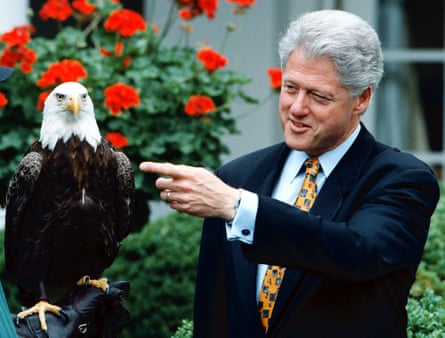
President Clinton meets Challenger, a 10-year-old male bald eagle in the Rose Garden of the White House before an event celebrating the success of the Endangered Species Act by announcing action to remove the American bald eagle from the endangered species list, on 2 July 1999.
President Bill Clinton meets Challenger, a male bald eagle in the Rose Garden to celebrate the success of the Endangered Species Act by announcing action to remove the American bald eagle from the endangered species list, on 2 July 1999. Photograph: Georges De Keerle/Getty Images
Even the location of the photograph used by the White House reflects the unlikely recovery of the population. The image was captured by Derek Stoll in New York state, which by the 1970s had just a single breeding pair.

“You’re not allowed to import bald eagles. So there was a population in Canada, but we are not allowed to bring bald eagles into the United States,” Darryl McGrath, the Albany-based author of Flight Paths, said during a 2016 lecture. “So we couldn’t get the eagle chicks for this hacking project – we couldn’t get them from Canada, even though Canada was very willing to help us out.” Instead, New York relied on other states, including Alaska, until laws concerning the transport of endangered species were amended.

Other eagles were sourced for the US from the coastal provinces of British Columbia and Nova Scotia, including 36 from Cape Breton sent to repopulate New Jersey and Massachusetts.

Bird says that the people trading memes about the eagle and the goose may not know the shared history of a key conservation success story. But he points out that even if Canada geese look like easy prey for an eagle – and they can be – they are also “formidable” birds and can easily break the wings of a eagle. And he notes that another beloved Canadian bird – which adorns Canada’s one-dollar coin – should similarly not be underestimated.
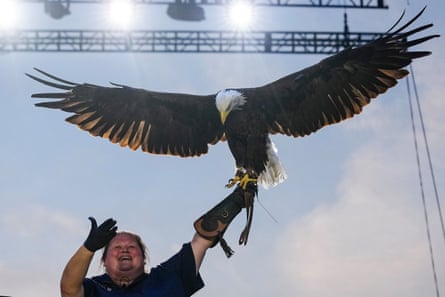
Lincoln The Bald Eagle flies over the crowd during the UFC Freedom 250 ceremonial weigh-in at The Ellipse on 13 June 2026 in Washington, DC.
Lincoln The Bald Eagle flies over the crowd during the UFC Freedom 250 ceremonial weigh-in at The Ellipse on 13 June 2026 in Washington DC. Photograph: Chris Unger/Zuffa LLC
In 2020 an eagle was found floating lifelessly in a Maine lake. A necropsy confirmed what experts suspected – the eagle threatened a common loon and its chick.

“It stabbed the eagle through the heart with its beak,” said Bird, adding that given the current political climate, the symbolism is “hard to ignore”.

The Guardian Verified Source

Reported by https://www.theguardian.com/profile/leyland-cecco · Syndicated via official news feed

Explore all Breaking stories

Syndicated feed content with full publisher credit.