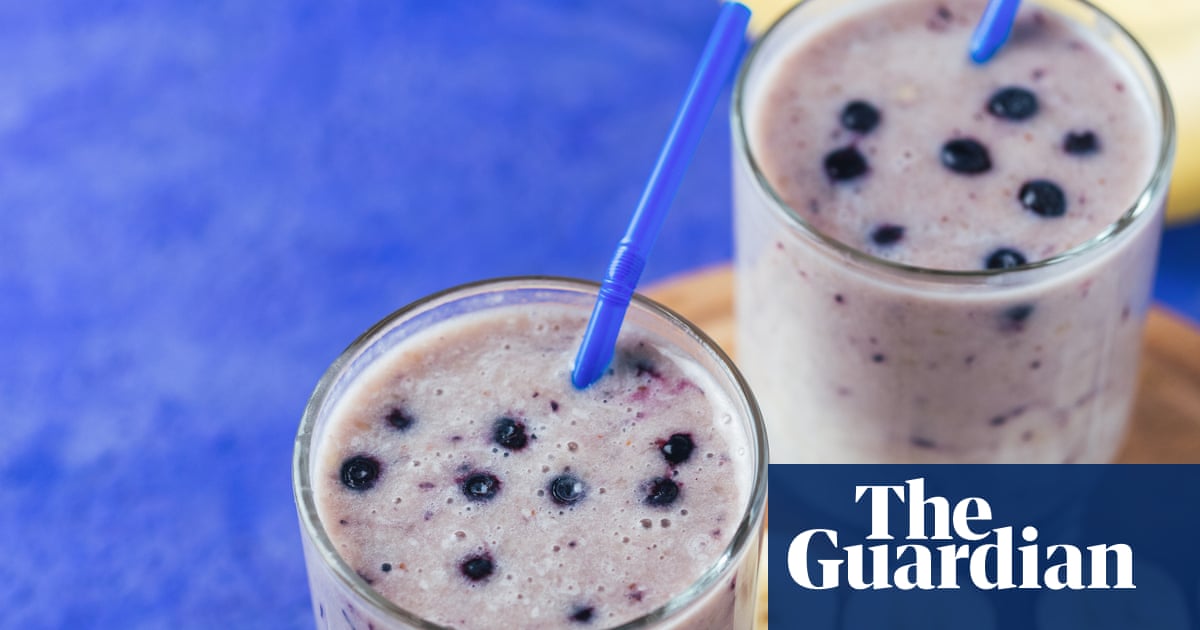
But this summer, the Mel Robbins Podcast featured Dr Rhonda Patrick, a biomedical scientist, who said that adding banana to a blueberry smoothie could adversely affect the nutritional benefits of the berries.
Could the beloved mashup of blueberries and bananas really be a bad match?
What is the claim about bananas affecting the nutritional value of blueberries?
“Polyphenol oxidase, it’s essentially an enzyme that’s breaking down the polyphenols. And there have now been studies … showing if you add bananas to blueberries, you’re not getting as many polyphenols. In fact, it’s quite a bit lower. So the banana is killing the benefit,” she said.
The most likely source for Patrick’s claim is a 2023 study that explored how polyphenol oxidase affected the body’s absorption of particular polyphenols called flavanols.
The study found that participants who drank banana smoothies with added flavanol had lower blood levels of these antioxidants than those who drank mixed-berry smoothies with the same additive.
Does this study support the banana-blueberry claim?
There are a few reasons not to rely too heavily on this study for this specific claim.First of all, the researchers “never, ever made a smoothie with bananas and blueberries together”, says Dr Joe Schwarcz, a science communicator and director of McGill University’s office for science and society.
Further, the study “only had eight subjects … not a big enough number to have significant conclusions”, says Schwarcz.
But zooming out to the effects of polyphenol oxidase on flavanols, “there is a statistical difference in the amount of polyphenols that may be present in your smoothie as the result of the banana,” says Schwarcz.
I reached out to Patrick at her health content company, FoundMyFitness, to clarify her claim. A spokesperson, Dan (their full name was not provided on request), responded by email: “The fact that this enzyme breaks down some polyphenols is essentially beyond reproach and not dependent on any one study she cites.”
A body of research does support that polyphenol oxidase influences the antioxidative capacity of different compounds in fruit and vegetables in various different ways.
Anthocyanins are associated with a range of potential health benefits, including reduced risk of overall mortality, cardiovascular disease and type 2 diabetes.
Thus, what this study measured was “not even the important compounds of blueberries”, says Schwarcz.
Finally, this study was funded by the Mars company – and the flavanols used in this project were derived from cocoa.
“And it just so happens that [Mars] sells flavanol supplements” and chocolate, which contains flavanols, says Schwarcz.
Can nutrients actually ‘cancel each other out’?
Yes, they can. “Nutrient interactions in food are actually quite common,” says Alyssa Northrop, a registered dietitian based in Minneapolis.But in the grand scheme of your diet, Northrop says you shouldn’t lose sleep over such interactions.
“Rather than trying to micromanage every food combination, I encourage people to focus on the bigger picture: eat a varied diet with plenty of fruits, vegetables, whole grains, nuts, seeds and other nutrient-dense foods to meet your body’s needs,” she says.
Eating too few fruits and vegetables is a bigger concern than optimizing polyphenol absorption from every smoothie, says Northrop.
“Most of us aren’t consuming the recommended five servings of fruits and vegetables daily. If adding a banana makes a berry smoothie more delicious and encourages someone to eat more fruit, I see that as a win,” she says.
“Bananas are often added to smoothies for their natural sweetness and unique texture that can make the smoothie thick and creamy,” says Sheri Gaw, a registered dietitian nutritionist based in the San Francisco Bay Area. Furthermore, bananas are easily accessible, inexpensive and healthy. They contain potassium, vitamin B6, vitamin C, manganese and magnesium, along with about 3 grams of fiber per medium fruit.
Should we be worried about not getting enough polyphenols?
Polyphenol-rich foods have been associated with a range of potential health benefits, including supporting cardiovascular and metabolic health, promoting a healthy gut microbiome, and helping prevent chronic diseases, says Northrop.Evidence suggests that consuming between 400 and 600mg of flavanols daily from foods such as green tea, cocoa and apples may support cardiometabolic health, including potential improvements in blood pressure, cholesterol and blood sugar regulation.
If you’re really worried about your berry smoothie’s flavanol levels, add fruit that is lower in polyphenol oxidase than banana, such as mango or pineapple.
Or, experiment with different ingredients. “Oats, yogurt, silken tofu, kefir, avocado and frozen cauliflower are popular smoothie add-ins that can offer a similar creamy thickness as a banana,” Gaw adds.
Do I really need to stop putting bananas in my berry smoothie?
“In the context of your overall diet,” the interplay of bananas and berries is “insignificant”, says Schwarcz. Overall, it’s good to eat a variety of fruits, and we benefit from their varied antioxidant compounds.Schwarcz has seen the idea of focusing on a specific food component and its impact on human health bubble up in nutrition literature for years.
“Your health is a very complex business of nutrition, of genetics, of your activity levels. And to try to make a big deal out of whether you put a banana in your smoothie or not – it’s just scientific nonsense,” he says. “It makes no practical difference in your life.”